
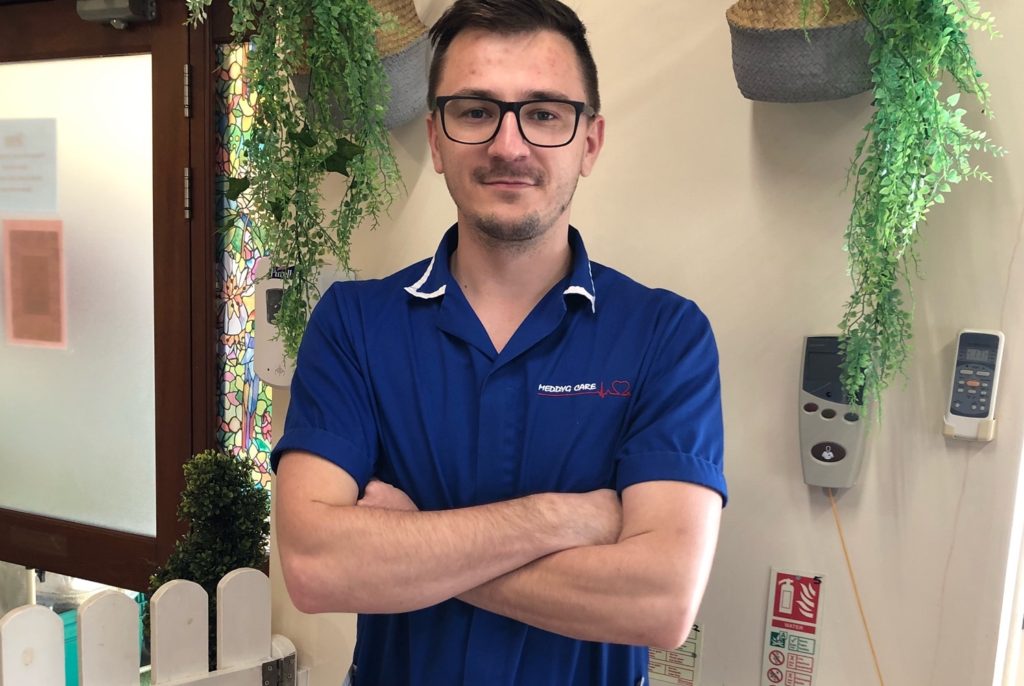
A day in the life of a carer at Meddyg Care
Working in care, particularly at a dementia specialist care home like Meddyg Care, can be demanding but it offers a chance for a varied and fulfilling career with the opportunity to directly affect the lives of others in a positive way.
Ionut Dragos, known as John to residents and colleagues, has worked at Meddyg Care since 2016 and believes that while the needs of our residents might not change, every day is different in some way.
The 29-year-old, who is originally from Romania and has lived in Criccieth with his wife and baby girl for four years, says that although he’s recently made the step up to a more supervisory role so spends less time working directly with residents, he still finds it to be one of the most gratifying parts of the job.
Ionut said: “I enjoy doing staff allocations and making the shifts go smoothly, but I like to get involved on the shop floor because it’s important to know what’s happening.
“Not everybody is made for this, but for those that are, it’s very rewarding. It can be challenging as most of our residents are in the later stages of dementia, but it’s very satisfying when them and their families are all happy.
“I’m very proud of my team: they’re really good carers, we always try and make everyone happy, and we’ve worked hard to get to this level, and everybody’s ideas are welcomed.”
How the day unfolds
The shifts are all generally 12 hours, with either a morning or evening start working right from 8am up until 8pm, or 8pm until 8am, with staff usually assigned three shifts per week.
Ionut continued: “The day starts with offering personal care according to individual plans, which could include washing, dressing and taking care of personal hygiene to help them get ready for the day. Every person is different, so everyone has their own needs, likes and dislikes.
“After that, staff will take their own breaks and we’ll serve breakfast, which is followed by more personal care for anyone that needs it, and then we bring out drinks and snacks such as tea and coffee, cakes, biscuits and yoghurts. Anything with chocolate goes down especially well.
“Then we have morning activities, which could be reading the newspaper, watching TV or listening to music, up until lunchtime at 12pm, but there are other caring responsibilities we do throughout the day as well.
“Lunch tends to take about an hour and a half, then the staff take turns for their own lunch breaks, with the other half moving onto turning the bed-bound residents, which we do every two hours. The seniors like me and the nurses then help with activities or other care needs.
“In the past we’ve had someone in specially to offer an activity: we try to provide as much entertainment as possible. We might go out in the garden and enjoy the sun if we can, but if it’s rainy we’ll be inside, with puzzles, TV, music, documentaries or films: we have some big fans of the old westerns.
“At about 3.30pm we have another round of snacks: every resident can ask for tea or coffee whenever they want, but we have regular times when we make sure we’re being proactive with this as well, for those that can’t ask.
“4.30pm we have another round of personal care, and then tea-time starts. After that we work through until handover and the end of the shift and we log it all in an app to make sure everything is done properly.
“We find a set routine like this really helps our residents and lessens confusion”
Work and life in proportion
Working a full-time job in less than a normal working week can be difficult but offers
a different kind of balance.
“The three days on, they can be challenging, but it works out well, and you need that time off,” he said.
“My wife and I have a little one as well, so we can be very busy.
“I love my schedule, I love the routine, and the management are really supportive, that really makes a difference. I wouldn’t change a thing now.
“After the end of the day, I don’t watch a lot of TV but might watch a film on Netflix or Amazon.
“If I can, I like to play a bit of table tennis, or when the weather is warmer, tennis outside. I have a few friends who I like to do that with, I’m looking forward to getting back out and stretching my legs.
“I like other sports too, I do a bit of running, it’s good to keep physically and mentally fit.”
After five years working at the specialist care facility, Ionut believes society at large needs to get a greater appreciation of how dementia affects people.
He concluded: “It changes the behaviour of a person completely; they can often not be the same person anymore. Dealing with it is much, much easier once you accept that and once you learn the new behaviours that that person has.
“But people looking in from outside can just see the bad side, the shouting that happens because the resident might just choose to express themselves like that for example.
“With Covid, it’s a shame because we can’t welcome more people in, but everyone should have the opportunity to work half a shift with us to see what it’s like.”
Comments are closed